Unified Is Dead. Meet the Symbiotic eClinical Platform.
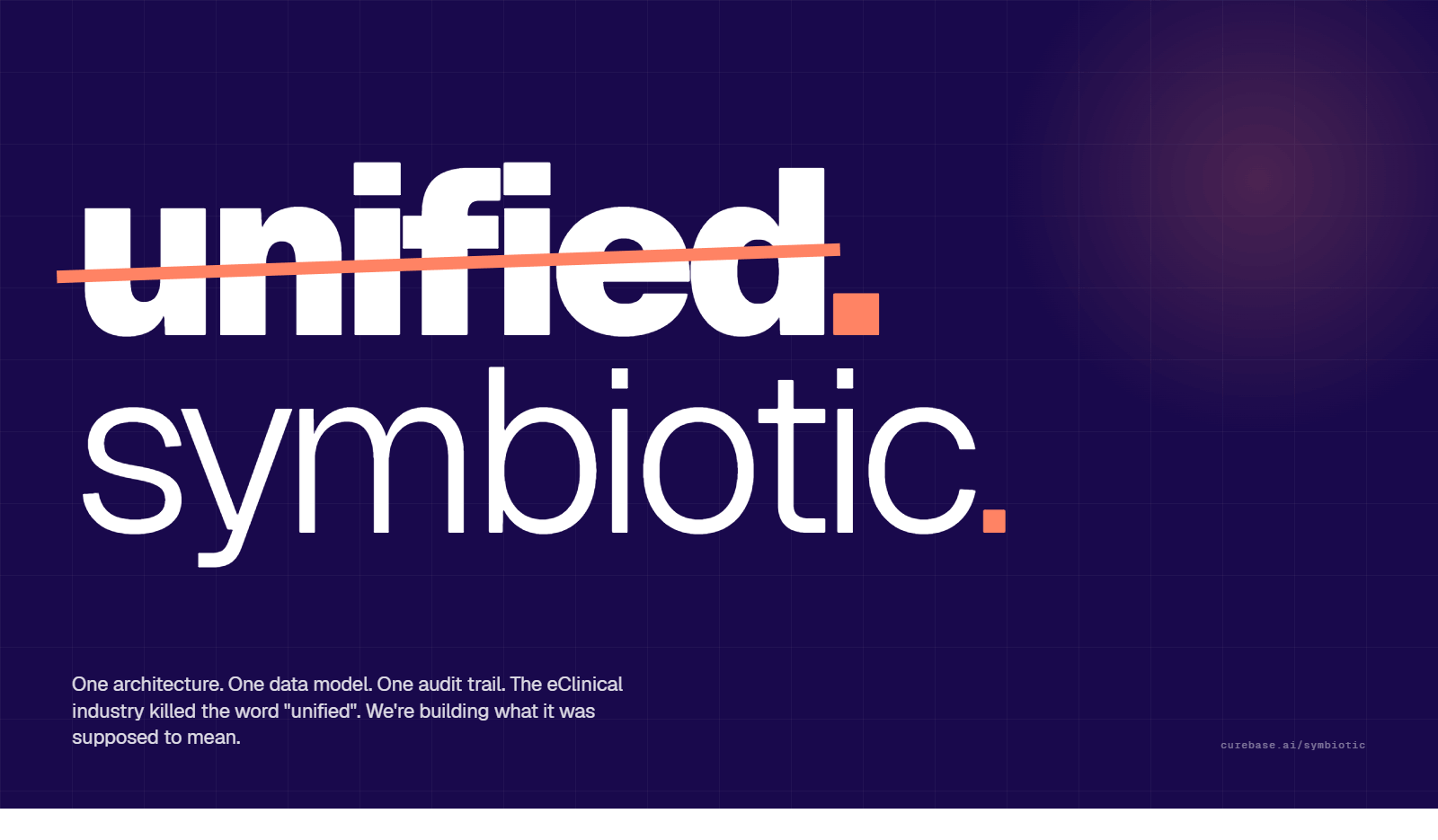
The eClinical industry killed the word unified.
For years, vendors have acquired point solutions, wired them together with integrations, painted them the same color, and called the result a "unified platform." The market is left squinting at product diagrams, wondering what is actually one system and what is just well coordinated marketing.
At Curebase, we stopped using the word. Instead, we're building what "unified" was supposed to mean: a single architecture and a single data model where modules are not just connected, they are symbiotic.
What "Unified" Became in eClinical
On paper, a unified platform sounds simple: one place to run your trial. In reality, most "unified" offerings look more like this:
- Acquired products stitched together behind an integration layer
- Multiple databases that have to be synced, mapped, and reconciled
- Separate audit trails, configuration models, and user experiences
Those architectures create very real pain for a Head of Clinical Operations:
- Slower study builds because each module has its own design tools and data structures
- Fragile workflows that break when a webhook fails or an upgrade changes a field
- Reconciliation overhead across EDC, ePRO, eConsent, and site tools that were never built to share a brain
Unified became "branded together," not "built together."
Defining the Symbiotic Platform
A symbiotic eClinical platform is not just one login or one logo. It is one living system where modules share the same data model, metadata, and workflow engine from day one.
At Curebase, that means:
- One architecture: eConsent, ePRO, EDC, and site tools run on the same core platform, not on parallel stacks bound by APIs.
- One data model: the participant, visit schedule, forms, and events live in a single database with a common schema and a single audit trail.
- One workflow engine: tasks, notifications, and automations flow across modules without needing hand-offs between systems.
In a symbiotic platform, modules don't just coexist; they make each other better.
Example: When a participant signs eConsent, the visit schedule is instantly aware because they are the same system. Your ePRO knows which procedures occurred in EDC because it is reading from the same data, not a copy that arrived through a nightly sync.
Symbiotic vs "Unified": Architecture at a Glance
| Dimension | Typical "Unified" Platform | Symbiotic Platform |
|---|---|---|
| Connection | Integrations, syncs, and webhooks between products | Native relationships in a single architecture |
| Data | Many databases mapped and reconciled | One database and one audit trail |
| Configuration | Separate study builds per module | One study model powering all modules |
| Workflow | Stops at product boundaries with manual bridges | Flows across modules automatically |
| Change management | Every upgrade requires retesting integrations | Changes propagate through one system |
| Origin story | Acquisitions and stitching | Built as a single platform from day one |
Why Symbiosis Matters for Sponsors and CROs
Clinical teams do not buy architecture diagrams; they buy outcomes. A symbiotic platform shows up in the day-to-day in ways that matter to a Head of ClinOps.
Faster study startup
One build populates eConsent, ePRO, and EDC because they share a study model and data definitions.
Cleaner, AI-ready data
There is one version of the truth, so data pipelines, reporting, and AI models don't have to reconcile six overlapping datasets.
Continuous, cross-module workflows
Patient state is tracked end-to-end: recruitment, eConsent, ePRO, visits, and follow-up, without workflow gaps between systems.
Lower operational risk
With fewer moving parts and no brittle integrations, there are fewer failure points mid-study.
In other words, symbiosis turns "we connected our tools" into "our tools share a nervous system."
How Curebase Is Building a Symbiotic Platform
We are not claiming perfection. Building a truly symbiotic platform is hard, and there are parts we are still evolving. But there are a few non-negotiables in how we engineer the Curebase platform:
- Native modules, not acquisitions: eConsent, ePRO, EDC, and site software share core services and infrastructure.
- Common metadata layer: forms, visits, roles, and workflows are defined once and reused everywhere.
- Single audit trail: one place to understand what happened, when, and across which module.
- Open at the edges: where external integrations are required, they plug into a consistent core rather than into each other.
This is what allows us to say "symbiotic" with a straight face.
What This Enables Next
Once you stop stitching and start sharing, new possibilities open up:
- AI that reasons over the entire patient journey instead of a handful of siloed extracts
- Adaptive workflows that respond to real-time patient behavior across channels
- Simplified oversight for sponsors, CROs, and sites because everyone is looking at the same system of record
Symbiosis is not a tagline. It is a roadmap for how modern eClinical should work.
An Invitation to the Industry
We are not trying to win a semantics debate. We are trying to reset expectations.
If your platform is six products with a shared color palette, call it what it is. If you are building a single architecture and a common data platform, own that, and show your work.
We chose the word symbiotic because it reflects what we're aiming for: modules that grow from the same core and make each other better over time. If that resonates, we invite you to:
- Challenge us on where we are and are not yet symbiotic
- Ask your current vendors how many databases, audit trails, and study models are behind their "unified" diagrams
- Join the conversation about what comes after "unified" in eClinical
Because patients deserve better than stitched-together systems. And so do the teams running their trials.