
CNS Summit 2026
Adaptive eSource for Clinical Trials: One EDC Build, Every Site's Workflow
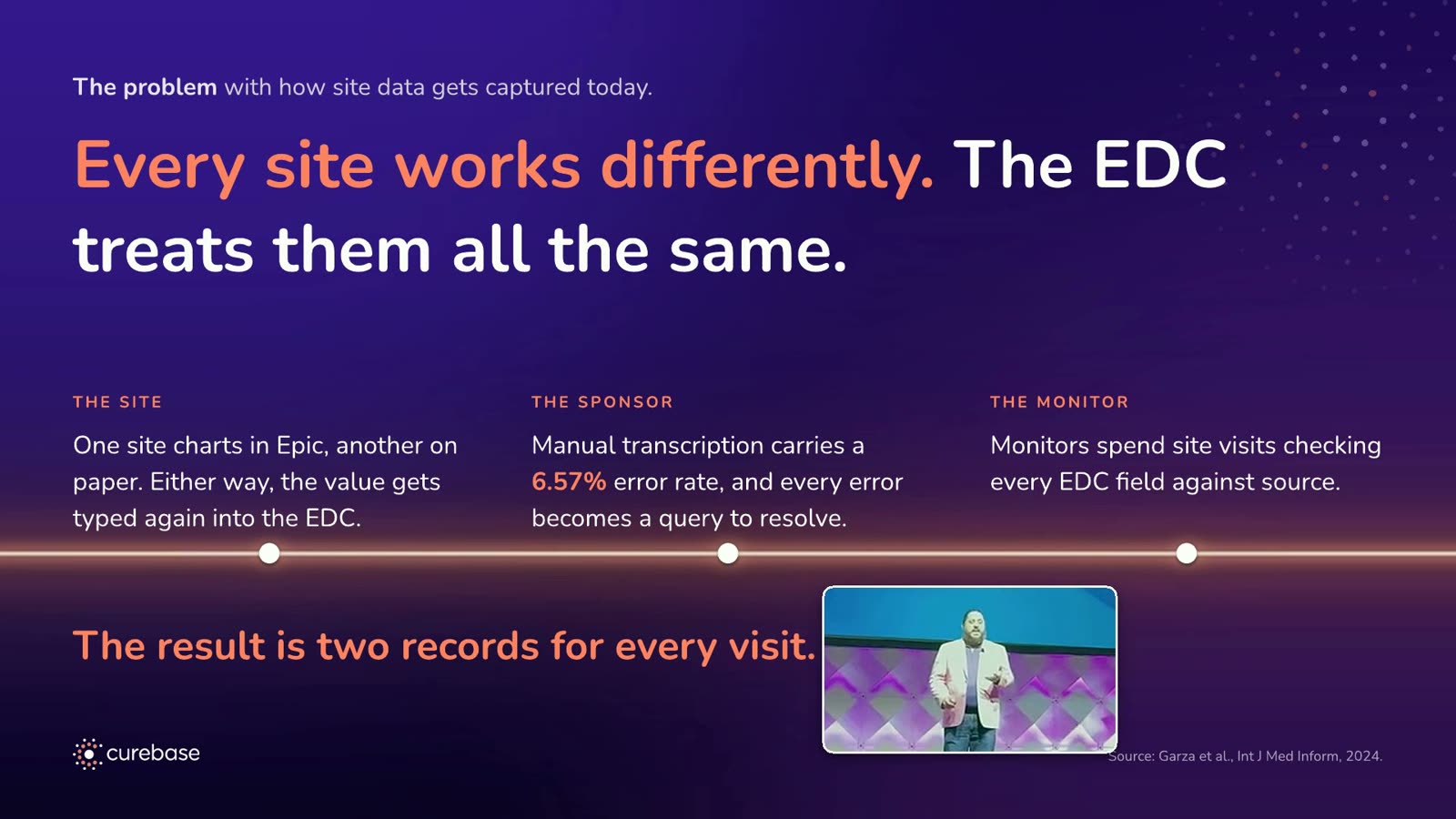
Every research site works differently. One charts in Epic, another records source on paper worksheets. Yet traditional EDC treats them all the same, so the value gets typed again into the EDC and every visit ends up with two records.
At CNS Summit 2026, Curebase introduced Adaptive eSource: one EDC build from the sponsor that each site adopts on its own terms. The sponsor owns what data gets collected. The site owns how.
Watch the CNS Summit 2026 Talk: Adaptive eSource in Action
See the full 8 minute presentation and live product demo from CNS Summit 2026.
The cost of double data entry in clinical trials
Manual transcription into EDC carries a 6.57% error rate (Garza et al., Int J Med Inform, 2024). Each error becomes a query to resolve, or worse, bad data. Monitors then spend site visits checking every EDC field against source.
Key takeaways from the CNS Summit 2026 talk
- Build the study once: AI reads the protocol, extracts visits, activities, and stages, and generates a casebook where every field traces back to the protocol.
- Sites choose source or transcription: Each site decides, form by form and field by field, what it captures as original eSource and what it transcribes, like traditional EDC.
- One identical data set: Different site workflows converge into the same structured data set with no mapping and no reconciliation.
- Targeted, risk-based SDV: Rules by site risk, form, and field narrowed one example from 121 fields to nine requiring verification. Source fields skip SDV entirely.
- Paper backup with AI capture: If a site has to fall back to paper, a tablet photo lets AI fill in the form for review, and the reason is recorded.
"The sponsor owns what gets collected, but the sites actually get to decide how."
EDC and eSource in one workflow
Adaptive eSource combines Curebase Electronic Data Capture with eSource, so coordinators enter data once and monitors review only what matters. It builds on Curebase Targeted SDV for risk-based source data verification.
Frequently asked questions
What is adaptive eSource in clinical trials?
Adaptive eSource lets each research site decide, field by field, whether data is captured directly as electronic source or transcribed from another record, all within one EDC build created by the sponsor.
How does eSource reduce source data verification?
Data captured at the point of care as original source has no second record to compare against, so those fields do not need SDV. Monitors focus only on transcribed fields flagged by the risk-based plan.
Why does manual transcription matter?
Transcribing from EHRs or paper into an EDC creates two records for every visit. Published research cites a manual transcription error rate of about 6.57%, and each error can become a query.
Do all sites have to use eSource the same way?
No. One site can capture 90% of fields as source while another starts with demographics only. The sponsor's study and data set stay the same.
The sponsor owns what data gets collected, and the site owns how. The problem is that every site is different, but when we work with EDCs we treat them as if they're all the same. One site is using Epic to record source data; another has a paper worksheet as their source documents. Both of those sites need to get that same data into the EDC. That results in two records for every visit.
The problem for the sponsor is that manual transcription has an error rate of over 6%. Every error, in a good case, raises a query that needs to be resolved. In a bad case, that's just bad data. And monitors spend hours and days on site confirming the data was entered correctly. If you just used source, that problem wouldn't exist.
With Adaptive eSource, a sponsor builds the study once. We take the protocol, ingest it, pull out the study design, and generate a casebook where every field and form is traced back to that protocol. In the next step, the sponsor creates a risk-based verification plan.
Then each site adopts that build on its own terms. We start with the one build created by the sponsor, and each site decides how it will enter data. Each site goes form by form and field by field and decides what is captured as original source and what is captured as transcribed data, like traditional EDC.
Here's an example of two sites with different ways of collecting their data, both captured in one system. It's the same study, the same build, and the data set is identical either way. The two paths converge into one data set. There's no mapping and no reconciling. Source fields come out of SDV entirely because they're source, so they don't need verification. And coordinators enter data once instead of double data entry.
Let me narrate a video of this. The first step is the sponsor uploading the protocol. The AI does a thorough read to understand everything in it, adds it to the platform, and pulls out the important parts: visits, activities, and stages. The user reviews everything and confirms it's correct before moving on. At this point, we have all the details of the clinical trial.
Next we generate the schedule of assessments. You can still edit here. It won't be perfect, but it's a great starting point for a study. Then we create a source data verification plan. In this example we start with three risk levels: high, medium, and low. You can create as many or as few as you like. We know our Hudson Valley site very well, so we set their risk to low.
Even low-risk sites have information you need to review, like adverse events. So we create a rule that adverse events are monitored at 100% SDV. Beyond rules, we can get very detailed at the form and field level. Here we set a lab form to 50% SDV, and for a key safety data point, ALT, we require 100% SDV on that one field. You can make this as granular as you need. We save the plan, there's a complete audit history, and you can update it later. With targeted SDV, we went from 121 fields to nine fields requiring verification.
Now a site accepts its invite to the EDC. This is where it gets interesting. They start with the overall plan the sponsor developed, and by default everything is transcribed. They decide what becomes source. This site isn't the most tech savvy, but they're getting into eSource, so they start with demographics: 26 fields marked as source, 121 as transcription. They save the plan and can update it later.
The sponsor has a view across every site in the project and can compare metrics like how fast data is arriving. Another site, Cascade Valley, is 90% source instead of transcription. Two sites, with vastly different plans.
Now data capture at a third site. The bar to the left of each field shows what's transcribed and what's source, plus a small indicator. Weight is marked as transcribed, so that's the one field they need to transcribe, and it's flagged as required because of how they set up their strategy.
Twelve days later, a participant comes in for their second visit and vital signs are due. That was a source field, but say the internet is down and they need to capture on paper. You can change your strategy; you just have to record why. Once the internet is back, they take a picture of the paper with their tablet, the AI reads it and fills out the form, and they review it for accuracy. Now it's in the EDC, just as if they entered it themselves.
Back to the sponsor to see what a monitor reviews. The SDV dashboard shows everything that needs monitoring, accounting for the strategy we built earlier and what each site captures as source or transcribed. The weight field we saw earlier is here, and on that form it's the only field that requires verification. Think about how much time is saved by not reviewing all the data. Everything captured as source doesn't need to be verified, because that's the one place it lives.
So, to recap: the sponsor owns what gets collected, and the sites decide how. We're combining our EDC with our eSource product into one workflow. That's Adaptive eSource. Come see us at the poster session tonight or tomorrow. I look forward to answering your questions. Thanks.